You are using an out of date browser. It may not display this or other websites correctly.
You should upgrade or use an alternative browser.
You should upgrade or use an alternative browser.
Random Fire House Pictures
- Thread starter Signal73
- Start date
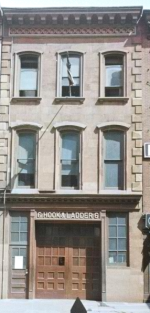
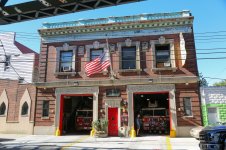
All great photos Bisket. Thanks for sending and keep going.FDNY Engine Co #39 & Ladder 16 - 157 E. 67th St
View attachment 58601

- Joined
- Jan 15, 2025
- Messages
- 359
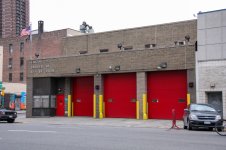
The Firehouse formally used by Engine 15 on Henry Street was damaged during renovations to the notable; landmark The Henry St. Settlement House located right next to the firehouse. As a member of TL-18 from 1977 to 1984 I worked overtime and details in E-15s Henry St. Firehouse, a great old classic firehouse. Does anyone know the status of the old Henry St. firehouse? I know when Engine 17 was closed Engine 15 moved into the firehouse of TL-18 and the 4th Battalion on Pitt. St. The Pitt. St. firehouse was built for 3 companies plus the Battalion. The Pitt St Firehouse was designed for use by Engine 17, Tower Ladder 18 and Squad 5 plus Battalion 4. Squad 5 was closed before the firehouse was finished,
I think Squad 5 was closed in 1975, but the name Squad 5 was over the main apparatus door. Captain Bob Rainey FDNY Engine 26 retired.
I think Squad 5 was closed in 1975, but the name Squad 5 was over the main apparatus door. Captain Bob Rainey FDNY Engine 26 retired.
Capt. E15 didn't move the same time E17 was closed. E15 was on Henry St for the years I worked in lower Manhattan as a paramedic and TL18 and B4 were by themselves on Pitt St. That was from 1995-2002. I'm not sure what year E17 was closed, but I don't remember ever seeing 17.The Firehouse formally used by Engine 15 on Henry Street was damaged during renovations to the notable; landmark The Henry St. Settlement House located right next to the firehouse. As a member of TL-18 from 1977 to 1984 I worked overtime and details in E-15s Henry St. Firehouse, a great old classic firehouse. Does anyone know the status of the old Henry St. firehouse? I know when Engine 17 was closed Engine 15 moved into the firehouse of TL-18 and the 4th Battalion on Pitt. St. The Pitt. St. firehouse was built for 3 companies plus the Battalion. The Pitt St Firehouse was designed for use by Engine 17, Tower Ladder 18 and Squad 5 plus Battalion 4. Squad 5 was closed before the firehouse was finished,
I think Squad 5 was closed in 1975, but the name Squad 5 was over the main apparatus door. Captain Bob Rainey FDNY Engine 26 retired.

- Joined
- Feb 27, 2015
- Messages
- 1,716
Engine 17 was disbanded on 1/3/91Capt. E15 didn't move the same time E17 was closed. E15 was on Henry St for the years I worked in lower Manhattan as a paramedic and TL18 and B4 were by themselves on Pitt St. That was from 1995-2002. I'm not sure what year E17 was closed, but I don't remember ever seeing 17.
Engine 15 was relocated to Fort Pitt on 11/19/01
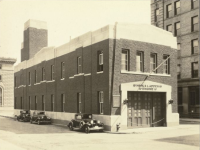
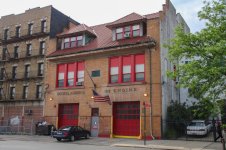
What is the structure attached to the rear of the firehouse? Did another company run out of there?FDNY Ladder Co #2 - 126 East 50th Street
View attachment 58603

- Joined
- Mar 3, 2007
- Messages
- 1,698
Proprobably the kitchen on the 1st floor and the bathroom on the 2nd floorWhat is the structure attached to the rear of the firehouse? Did another company run out of there?
Not likely a kitchen or bathroom.Proprobably the kitchen on the 1st floor and the bathroom on the 2nd floor
Some houses had additional quarters like these that housed a battalion or division chief (e.g., L4, E71.) The building was actually their home, in some cases including their families. Other such buildings were fuel depots. A wagon, lubricants and coal resources were stored there for use when steamers were frontline apparatus, prior to 1922. When a working fire or multiple alarm was transmitted, specific units, as assigned on the run cards, would unhitch their horses, ride them to these depots, then harness the horses to the coal wagons, and return to the scene to keep the steamers operating.
Prior to the 1920s implementation of the two platoon system fire houses did not contain kitchens. The members lived near the firehouse and went home for daily meals. As the department motorized these daily leaves were eliminated and the former hay and feed storage areas were converted to kitchens to accommodate the new shifts of the two platoon system.
I'm not sure who or what occupied this rear building for Ladder 2 but will try to do some research on it. Maybe Battalion 8?
Last edited:
- Joined
- Jan 15, 2025
- Messages
- 359
I was still active until July 2000. Up until my retirement I was on the Promotion list to Battalion Chief, due to politics my list number was never reached on the B.C. List. But being a somewhat senior Captain in Division 1 and being on the B.C. promotion list, I was often acting Battalion Chief.
A few of those times I was acting Battalion Chief in Battalion 4, quartered with TL-18 where I had been a firefighter. I retired July 17th, 2000, and so I was not sure of the date that E-15 moved into Pitt. St. Interesting information thank you,
NOTE at one time before WW II, FDNY Engine 17 was the busiest Engine Company in the world. How do I know? On the wall near the kitchen in the Pitt. St. firehouse was posted a magazine article I think from the 1920's saying that Engine 17 was the busiest Engine in the FDNY and the World. Even when I came back from the layoffs in March of 1976 Engine 17 was in the top 20 busiest Engines in the FDNY.
Captain Bob Rainey FDNY Engine 26 retired.
A few of those times I was acting Battalion Chief in Battalion 4, quartered with TL-18 where I had been a firefighter. I retired July 17th, 2000, and so I was not sure of the date that E-15 moved into Pitt. St. Interesting information thank you,
NOTE at one time before WW II, FDNY Engine 17 was the busiest Engine Company in the world. How do I know? On the wall near the kitchen in the Pitt. St. firehouse was posted a magazine article I think from the 1920's saying that Engine 17 was the busiest Engine in the FDNY and the World. Even when I came back from the layoffs in March of 1976 Engine 17 was in the top 20 busiest Engines in the FDNY.
Captain Bob Rainey FDNY Engine 26 retired.
- Joined
- Sep 25, 2013
- Messages
- 1,021
Units assigned at various times:Not likely a kitchen or bathroom.
Some houses had additional quarters like these that housed a battalion or division chief (e.g., L4, E71.) The building was actually their home, in some cases including their families. Other such buildings were fuel depots. A wagon, lubricants and coal resources were stored there for use when steamers were frontline apparatus, prior to 1922. When a working fire or multiple alarm was transmitted, specific units, as assigned on the run cards, would unhitch their horses, ride them to these depots, then harness the horses to the coal wagons, and return to the scene to keep the steamers operating.
Prior to the 1920s implementation of the two platoon system fire houses did not contain kitchens. The members lived near the firehouse and went home for daily meals. As the department motorized these daily leaves were eliminated and the former hay and feed storage areas were converted to kitchens to accommodate the new shifts of the two platoon system.
I'm not sure who or what occupied this rear building for Ladder 2 but will try to do some research on it. Maybe Battalion 8?
Engine 8 temporarily
Hose Relay Wagon 2
Ladder 2-2
Ladder 16 temporarily
Division 3 temporarily
Battalion 8
Battalion 11 briefly
Battalion 16
Fuel Depot 14


- Joined
- Apr 25, 2008
- Messages
- 797
I believe they went to 21 Engine first; local merchants and the Cathedral put up a fuss about the move. ^^^^ hence the Quonset Hut.
- Joined
- Sep 25, 2013
- Messages
- 1,021
They went to E21 in 1957, then to E 50th St in 1960, until 1961 when they moved into their new house.I believe they went to 21 Engine first; local merchants and the Cathedral put up a fuss about the move. ^^^^ hence the Quonset Hut.