You are using an out of date browser. It may not display this or other websites correctly.
You should upgrade or use an alternative browser.
You should upgrade or use an alternative browser.
FDNY's Most Famous Firehouses
- Thread starter Disp51
- Start date


- Joined
- Apr 23, 2018
- Messages
- 1,277
Great video! It brought back a lot of memories—I was detailed to Ladder 8 and L 103 many times to drive, detailed to Ladder 10 quite a bit (and was in quarters there on 9/11), and was assigned to the "Big House" with Ladder 31.
Just wanted to share a few fun historical notes to add to the video. Regarding Ladder 8, something that wasn't mentioned is that when they cut the firehouse in half, they actually slid the finished Varick Street side over to replace the side that was removed!
As for Engine 31, it wasn't just a single-engine house back in the day. At one time, there were 17 horses housed there, including rigs for a Chief, a fuel tender, and a water tower. Plus, the firehouse had straight stairs, which debunks the old myth that firehouses needed spiral staircases just to keep horses from climbing them!
Finally, while the video singles out Engine 82 as the busiest company, we can't forget Engine 85. Because 82 was doing so many runs, Engine 85 was actually created to help cut their workload in half by splitting their first due boxes. Together, 82 and 85 were two of the busiest engines in the city, and on many nights, 82's house was stacked with covering companies.
Last edited:
I would include all the remaining Brooklyn FD houses that are still standing. May not be ‘famous’ in some eyes but have history that needs to be remembered.
Just a few that I can remember E 204 (RIP) , E 224, E 228, E236, E240, E 249, L122. Can a memory master fill in the ones I missed,
Just a few that I can remember E 204 (RIP) , E 224, E 228, E236, E240, E 249, L122. Can a memory master fill in the ones I missed,
- Joined
- Apr 23, 2018
- Messages
- 1,277
I would also add the oldest working firehouse E 26 to that list.I would include all the remaining Brooklyn FD houses that are still standing. May not be ‘famous’ in some eyes but have history that needs to be remembered.
Just a few that I can remember E 204 (RIP) , E 224, E 228, E236, E240, E 249, L122. Can a memory master fill in the ones I missed,
- Joined
- Sep 25, 2013
- Messages
- 1,024
Most of the original BFD houses are still standing (45+ of 62). Many still have active companies. Others are re-purposed. Only a few were demolished. Nine built by the volunteers remain. All are well over 100 years old.I would include all the remaining Brooklyn FD houses that are still standing. May not be ‘famous’ in some eyes but have history that needs to be remembered.
Just a few that I can remember E 204 (RIP) , E 224, E 228, E236, E240, E 249, L122. Can a memory master fill in the ones I missed,
Built to last with a lot of characterMost of the original BFD houses are still standing (45+ of 62). Many still have active companies. Others are re-purposed. Only a few were demolished. Nine built by the volunteers remain. All are well over 100 years old.
- Joined
- Jan 16, 2009
- Messages
- 2,951
B.M.A.RIP 232
The oldest continuously working house is E 5. It was never shut downI would also add the oldest working firehouse E 26 to that list.
Rode with Engine 248 and Battalion 41 from the old house at 2261 Church Avenue. This firehouse housed horses and there was drop door in he kitchen ceiling where hay was dropped down to feed the horses. We moved to a "new" firehouse in 1972 and still had a coal burning furnace in the basement for heat in the old housd. The "new" firehouse in 1972 was a combination firehouse and police precinct located at 2900 Snyder Avenue and remains active to this day.
- Joined
- Apr 23, 2018
- Messages
- 1,277
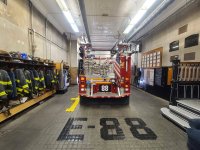
You can tell what firehouses had horses at one time by the scored grid pattern on the apparatus floor, designed so the horses can dig in and not slip.
- Joined
- Jun 27, 2017
- Messages
- 1,809
Another tip-off could be gutters (piss gutters) along an outside wall to allow easy hosing of the floor.You can tell what firehouses had horses at one time by the scored grid pattern on the apparatus floor, designed so the horses can dig in and not slip.
View attachment 59474
In general, if you're working in a firehouse built before WWI, you're spending a lot of time in the old stable.
In Baltimore, Engine Company 2 and the Sixth Battalion is at South Light and Montgomery Streets near the Inner Harbor. Built in 1920, it was the first BCFD firehouse without horse stables.

- Joined
- May 6, 2010
- Messages
- 18,051
In 1971 when we (LAD*108 & BN*35 ) moved from 112 Siegel St & ENG*216 moved from 11 Scholes St to 187 Union Ave the then new FH had no Hose Tower but had two large (pizza oven like) Electric Hose Dryers on the Apparatus Floor ....shortly after the switch was made from Cotton Jacketed Hose to Poly & drying was no longer required....the Hose Dryers were then just taking up space on the apparatus Floor....around 1980 when i was in R*2 we got Nick Ciampo our Good Friend & Shop Director ( & Mikes Dad ) to have one of the Dryers moved to Carlton Ave to be used to Dry Scuba Suits.
Browse Reference
In 1985 when we (R*2) moved to 1472 Bergen St (the original Qtrs of ENG*234 & BN*38) the FH had no Hose Tower ....inside Qtrs. one wall had slightly angle'd wooden trough's that originally were used to dry out / store Hose . .....also the FH even though two stories never had Poles.
In 1989 when I got assigned as a LT in ENG*332 the then FH w/LAD*175 was first occupied in 1985....it had no Hose Tower or any facility for Hose Drying....it also had no real heat on the Apparatus Floor.....if any heavily frozen Hose was brought back to Qtrs after a Winter job it was hung in one of the enclosed Pole Holes with an electric plug in home heater at the base.... the FH was 2 stories with all the Officer facilities on the first floor.....the second Floor had all the FF facilities.
Nice catch of detail there Dan.You can tell what firehouses had horses at one time by the scored grid pattern on the apparatus floor, designed so the horses can dig in and not slip.
View attachment 59474
Until recently, 88s quarters not only had the grid pattern for the horses hooves but also a small hole forward in the floor where the steamer would have been parked ahead of the hose wagon. Through the hole was a tube attached at one end to a small boiler in the basement and at the other end to the bottom of the big boiler on the engine. This kept hot water circulating through the steamer to allow the pumper to attain a quicker head of steam on the way to a fire. The housewatch journals of the day (E88 still has almost all of theirs going back a century) showed an entry checking the basement boiler pressure at the beginning of each house watch tour.
From the basement of quarters you could look up and see where the the tube went up through the ceiling to the apparatus floor.
I believe these quarters have since been renovated but when I helped write the history for the Centennial of 88/38 in November 2008 it was all still intact, a century after the house was constructed.
And by the way, the quarters of 88 / 38 are still famous for how well they are maintained, which is a tradition for that house that goes way back. Just before World War II L38 was graded the most efficient company on the job. Other reasons why it is known as a "West Point" house.
Last edited:
Some houses that had horses had steel plates on the walls where the stable was located so the horses didn’t kick the walls apart. E 276 , my last house, had these and there is still evidence of a pulley system on the ceiling where a pulley was used to drop the harness on the horses.The horse houses also had/have wooden wainscotting on the walls of the apparatus floor.
- Joined
- Apr 23, 2018
- Messages
- 1,277
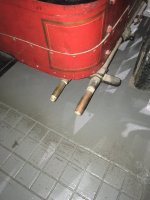
This is what you are referring to, this is E 30 quarters the museum.Nice catch of detail there Dan.
Until recently, 88s quarters not only had the grid pattern for the horses hooves but also a small hole forward in the floor where the steamer would have been parked ahead of the hose wagon. Through the hole was a tube attached at one end to a small boiler in the basement and at the other end to the bottom of the big boiler on the engine. This kept hot water circulating through the steamer to allow the pumper to attain a quicker head of steam on the way to a fire. The housewatch journals of the day (E88 still has almost all of theirs going back a century) showed an entry checking the basement boiler pressure at the beginning of each house watch tour.
From the basement of quarters you could look up and see where the the tube went up through the ceiling to the apparatus floor.
I believe these quarters have since been renovated but when I helped write the history for the Centennial of 88/38 in November 2008 it was all still intact, a century after the house was constructed.
And by the way, the quarters of 88 / 38 are still famous for how well they are maintained, which is a tradition for that house that goes way back. Just before World War II L38 was graded the most efficient company on the job. Other reasons why it is known as a "West Point" house.
- Joined
- Apr 23, 2018
- Messages
- 1,277
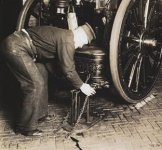
another view of the plumbing...